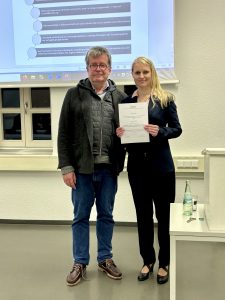



Dr. Alexandra Zeller, legal counsel at Bochum University of Applied Sciences, was awarded the prestigious research prize of the Association for the Promotion of Intellectual Property at the University of Münster at a ceremony on February 20. The award recognizes her outstanding dissertation on the legal entanglement of open access and export control in the context of international knowledge transfer.
The focus of the award-winning work is the fundamental right to freedom of science under Article 5(3) of the Basic Law and its relationship to security-related restrictions under export control law. The dissertation analyzes the increasing tensions between open scientific communication and the protection of security-relevant research. The relevant principles of EU and national law are systematically analyzed, as are practical uncertainties in the legal classification of specific research projects.
The prizewinner devotes particular attention to the compliance risks for scientists and academics as well as for universities and research institutions. The work shows that open access strategies, international collaborations and export control licensing obligations operate in a complex normative field of tension. Finally, the dissertation develops solutions for a sustainable balance between academic freedom, institutional responsibility and national security interests.
With the research prize, the Association for the Promotion of Intellectual Property, which brings together important companies from the Westphalian brand industry (e.g. Miele, Claas and Bertelsmann), underlines the high scientific and social relevance of the work. It makes a substantial contribution to the current debate on international research cooperation, dual-use problems and the legally secure organization of open science.
The event on February 20 also included the awarding of certificates for additional training in intellectual property law.
In addition, the new research group “AI and Copyright” was presented, which will in future deal in depth with the legal implications of generative systems, training data and protection concepts for creative work.